


Market Update November 2026
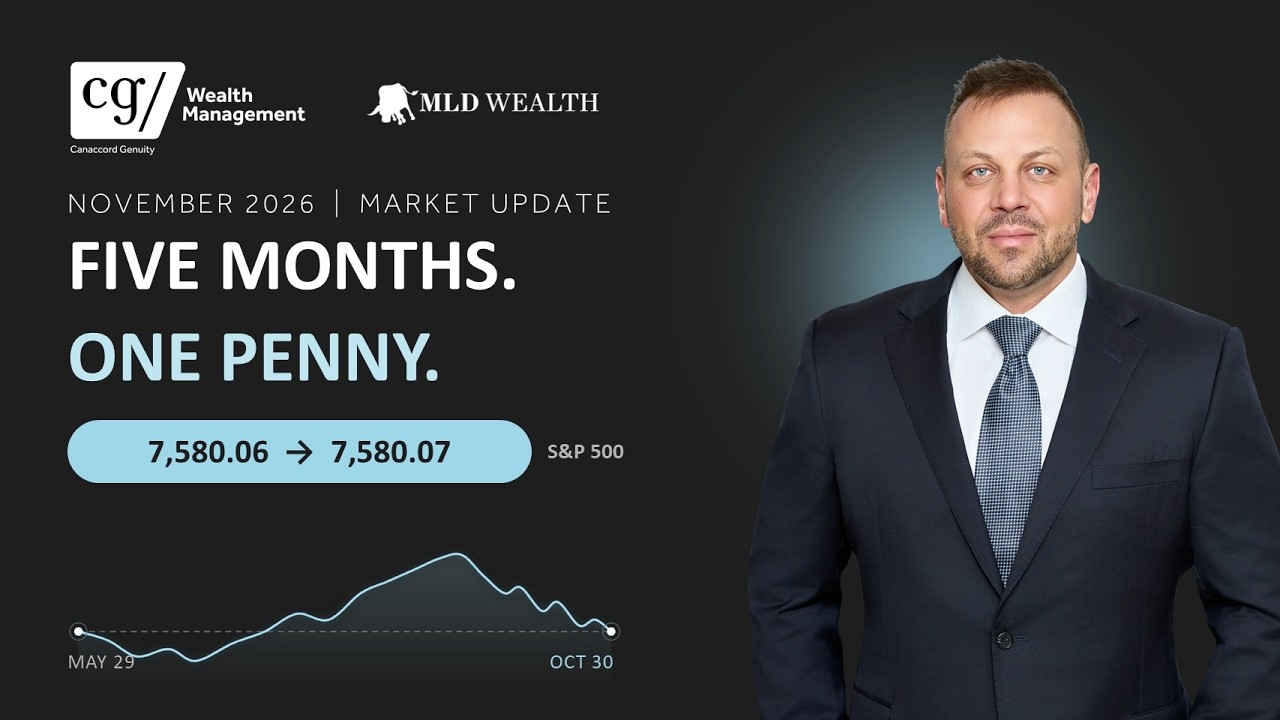
Five Months, One Penny
Markets
|
November 4, 2026
|
Chad Larson
Summary
Chad Larson explains that while the S&P 500 closed October just one penny higher than it did five months earlier, the market beneath the headline was anything but calm. Leadership rotated sharply, equal weight beat cap weight by the widest margin since 2009, and the market's worry shifted from interest rates to whether record AI spending will pay off. He argues that the physical backbone of the economy (power, copper, grid infrastructure and secure energy) benefits whether AI succeeds or disappoints, and that disciplined, genuinely diversified portfolios are built for exactly this kind of turbulence.
Highlights
- Five months, one penny: The S&P 500 closed at 7,580.06 on May 29 and 7,580.07 on October 30, despite a rate hike, a Fed pause, a record high and a late-month sell-off.
- The headline hid the pain: By mid-October the index was up about 13% on the year, but the median stock was up less than 6% and roughly 185 of its companies were down year to date.
- October was a month of sharp contrast: Technology fell about 8% and communication services about 10%, while energy rose about 14% and consumer staples nearly 11%.
- Breadth finally did the work: The equal-weight S&P 500 beat the regular index by 5.8 percentage points in October, its widest margin since 2009, after trailing it in September.
- Concentration has exceeded the dot-com peak: The top 10 stocks make up roughly 40% of the S&P 500, compared with about 27% at the height of the dot-com bubble, while generating only about 32% of its earnings.
- The worry shifted from rates to returns: The four largest hyperscalers have guided to roughly $720 to $745 billion of capital spending in 2026, nearly double 2025, and some are now borrowing to fund it.
- The grid is the bottleneck: Global data centre electricity use is expected to more than double by 2030, yet the median US power project connecting to the grid in 2025 waited more than five years in the queue.
- Copper held while the miners sold off: Copper sits only a few percent below its September record, yet the main copper producer index fell almost 14% in October as miners were sold alongside AI and growth names.
- The Fed paused without a road map: Rates were held at 3.75% to 4.00% in a 10 to 2 vote, with both dissenters favouring another hike and Chair Warsh declining to offer forward guidance.
- Energy led, and Canada benefits: Brent crude rose 13.6% in October, its fourth straight monthly gain, and Western Canadian barrels avoid the chokepoints driving global supply fears.
- Process over prediction: With US midterms underway, Chad emphasizes controlling what can be controlled: process, diversification, liquidity and behaviour.
Key Insights
1. A flat index is not a calm market.
Because the S&P 500 is weighted by size, a handful of large winners can mask widespread losses. Nike fell almost 40% this year while Micron rose more than 200%, and the index went nowhere as they cancelled each other out. Investors who felt October was worse than the headline number were not imagining it; they were feeling the cabin rather than reading the altimeter.
2. The backbone wins whether or not AI pays off.
AI models are the muscle, and nobody yet knows which will succeed. Every one of them, however, runs on physical infrastructure that takes years to build: power generation, transmission, transformers, copper and natural gas. That backbone is also being pulled by reindustrialization, electrification and defence spending, giving it many customers and many ways to win. Chips can be ordered next quarter; a grid hookup cannot.
3. Diversification is about surviving the worst months, not maximizing the best ones.
For years, owning anything outside the top 10 stocks looked like a drag. October showed the value of owning the rest of the plane. A portfolio built around 10 names has a single point of failure, while one built around the backbone of the economy, real assets, quality energy producers and equal-weight exposure has many paths to long-term returns.
Conclusion
The index went nowhere for five months while nearly everything beneath it moved. Breadth improved, the market's concern shifted to the payoff from AI spending, the Fed paused without signalling its next step and oil continued to climb. None of this changes MLD's long-term view: favour the backbone over the muscle, own quality real assets and energy businesses that earn well at $70 oil and exceptionally well above $110, and maintain diversification that truly diversifies.
The Takeaway Turbulence is uncomfortable, but it does not change the destination. Stick to the plan, own the physical backbone of the economy, and let process, not headlines, guide portfolio decisions.